Looking for a wheelie machine for sale? Commercial wheelie machines can cost tens of thousands of dollars. Here's what you're paying for, what to check before you buy, and how to build one for around $1,500 instead.
Short answer: Commercial wheelie machines can cost tens of thousands of dollars. Building your own costs around $1,500 in materials. Prefer one ready to ride? See our ready-built wheelie machine.
If you're looking for a wheelie machine for sale, the first thing you'll notice is the price. This guide covers what ready-made machines cost, what you're actually paying for, what to check before you hand over any money — and the cheaper way to get one into your garage.
Wheelie machine for sale: what they cost
Prices depend on who built the machine, what it's built from and whether it's new or used. Here's the realistic picture.
| Option | Typical cost | What to expect |
|---|---|---|
| Commercial machine | Tens of thousands of dollars | Ready to ride, plus freight to get it to you |
| Used machine | Varies with age, condition and seller | Cheaper up front, but you inherit someone else's build |
| Ready-built Wild Wheelies machine | From $10,000 | Made to order. Request a quote for a ready-built machine |
| Build your own | Around $1,500 in materials (depending on your local prices) + $59 plans | Built in your own garage, set up for your bikes, yours to keep |
For a line-by-line comparison, see our DIY vs. buying cost breakdown.
What you're paying for
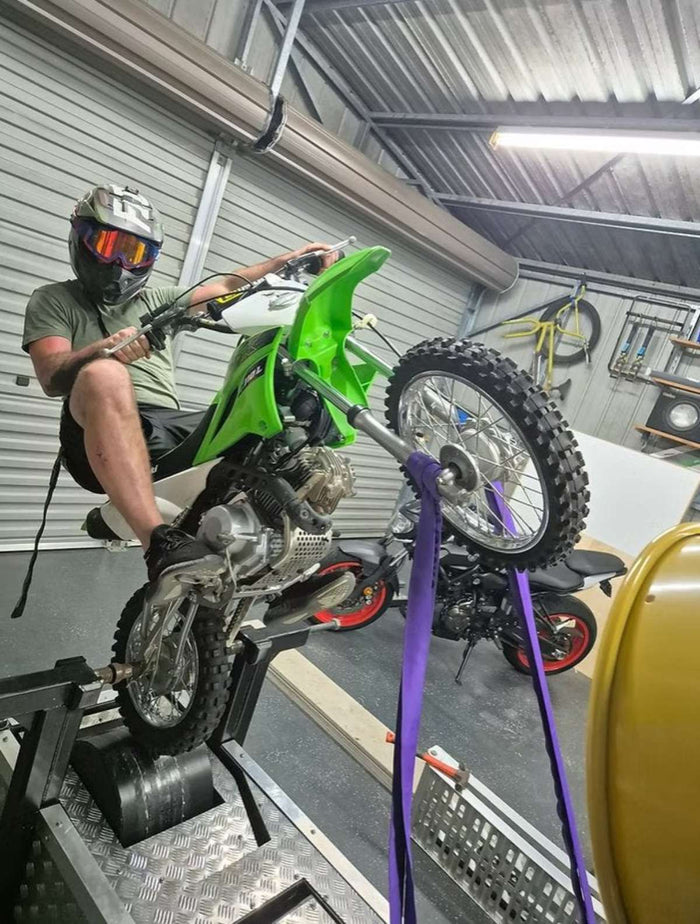
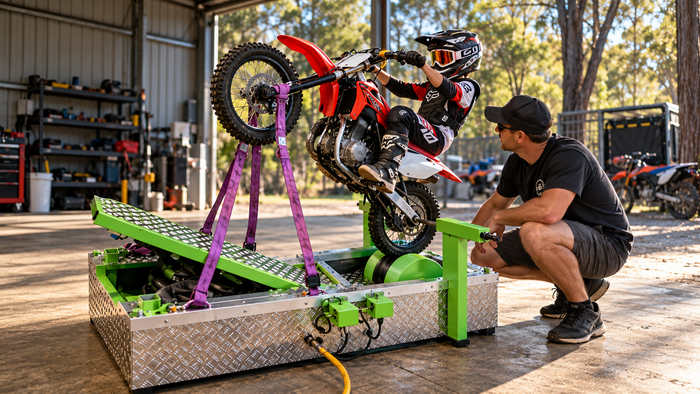
A wheelie machine isn't just a stand. Every serious machine — bought or built — comes down to the same core parts, and each one has a job. If you're new to how they work, start with what a wheelie machine is and how it works.
- The frame. The steel backbone everything else bolts to. It has to stay rigid and planted with a running bike on it.
- Rear axle mount on live centres. Holds the bike by its rear axle, so the wheel spins freely while the bike stays in place.
- Heavy roller. The rear wheel drives it, so it needs real weight behind it.
- Airbags for traction. They lift the heavy roller up to the rear wheel and set how much traction the tyre gets.
- Front safety straps. They limit how far the front can lift, so the bike can't loop over backwards.
- Sprung ramp. Cushions the front wheel on the way down and protects your fork seals.
- Cooling fans. A stationary bike gets no airflow, so fans keep the engine cool through long sessions.
When you buy a machine, you pay for those parts plus the builder's labour, their margin and the freight. When you build one, you only pay for the parts.
Ready to build one?
Skip the guesswork — get the complete step-by-step build plans.
Get The Plans — $597 things to check before you buy
- Will it fit your bike? Check that the axle mount and roller adjust to your wheelbase — and to every bike you plan to train on.
- Are the front safety straps included? The straps are what stop a loop-out. A machine without them isn't a training machine.
- Is there a sprung ramp? Without one, the front wheel slams down on every rep, and your fork seals pay for it.
- How is the bike held? Look closely at the rear axle mount. The bike should sit securely on the live centres with no play.
- What cooling comes with it? Fans aren't optional. A stationary engine with no airflow overheats.
- How does it move? Ask what it weighs and how it's transported. You'll want to get it home, and maybe to events.
- What's the real total? Add freight, any import costs and any parts you'll need to adapt it to your bike before you compare prices.
Buying a used machine: what to inspect
A used machine can save money, but you're buying someone else's build. Inspect it in person if you can, and ask to see it running with a bike on it.
- Welds and frame. Look for cracks, rust and repairs, especially around the axle mount and the roller supports.
- Live centres and roller. Spin the roller by hand. It should turn smoothly, with no wobble, grinding or play.
- Airbags. Check for cracks, leaks and perished rubber.
- Straps. Look for fraying, cuts and sun damage. If in doubt, replace them — they're your safety net.
- Ramp. Check that it moves freely and that the surface and mounting are sound.
- Fans and wiring. Run the fans and check the wiring for damage.
- Where it came from. Ask who built it and whether it was built from plans. A machine with no history is a gamble.
If anything critical is worn, factor the repair into the price — or walk away.
A cheap machine with worn straps isn't a bargain. It's a liability.
Skip the search — build your own
Get the plans — $59The cheaper way: build your own
The cheaper way to own one is to build a wheelie machine yourself. The materials cost around $1,500, depending on your local prices. The main items are:
- Cooling fans
- 2 airbags
- 2 live centres
- Steel for the frame
- A lead-filled roller
For tools, you'll need a welder, a grinder, a drill and a hammer. The full list is in our tools and materials checklist, and the build order is in how to build a wheelie machine.
The plans are 23 pages of drawings, with a cutting list and a parts list, so you know exactly what to cut and what to buy. The finished machine fits on a 6x4 trailer, so you can take it wherever you ride. The plans are an instant download and come with a 6-month money-back guarantee.
Buy or build?
| Buy | Build | |
|---|---|---|
| Cost | Tens of thousands of dollars | Around $1,500 in materials (depending on your local prices) + $59 plans |
| Tools | None | Welder, grinder, drill, hammer |
| Fit | Depends on the model | Set up for your own bikes |
| Getting it home | Freight | Built where it lives; fits a 6x4 trailer |
| Repairs | Depends on the seller | You built it, so you can fix it |
| Best for | Riders with the budget who want it ready to go | Riders who can weld, or know someone who can |
Rather not build it?
Want one built for you? Request a quote for a ready-built machine and tell us what you need.
Build your own wheelie machine
Get the plans — $59Don't want to build it yourself?
We build wheelie machines to order. Request a quote and we'll contact you personally.
Request a quote for a ready-built machineFrequently asked questions
How much does a wheelie machine cost?
Commercial wheelie machines can cost tens of thousands of dollars. Building your own costs around $1,500 in materials.
Is it cheaper to build or buy a wheelie machine?
Building is cheaper. You pay around $1,500 in materials, depending on your local prices, and $59 for the plans. Commercial wheelie machines can cost tens of thousands of dollars.
What should I check before buying a used wheelie machine?
Check the welds and frame for cracks, spin the roller to make sure it runs smoothly on the live centres, inspect the airbags and straps for wear, run the fans, and ask who built it.
What tools do I need to build one?
A welder, a grinder, a drill and a hammer. The plans include 23 pages of drawings, a cutting list and a parts list.
Can I transport a wheelie machine?
Yes. A machine built from our plans fits on a 6x4 trailer.
Build your own wheelie machine
Put this into practice. Get the complete DIY plans — instant download, fits any bike, 6-month guarantee.
See The Plans →